Unitree Robotics: Better Than the SuperEnalotto, Worse Than the Stock Market
Better than the SuperEnalotto, worse than the stock market: Unitree's IPO raised $1.2 trillion in orders for a $900 million offering. Between robots doing backflips, DeepSeek's backing, and Beijing's blessing, here's the story of China's most frenzied listing.

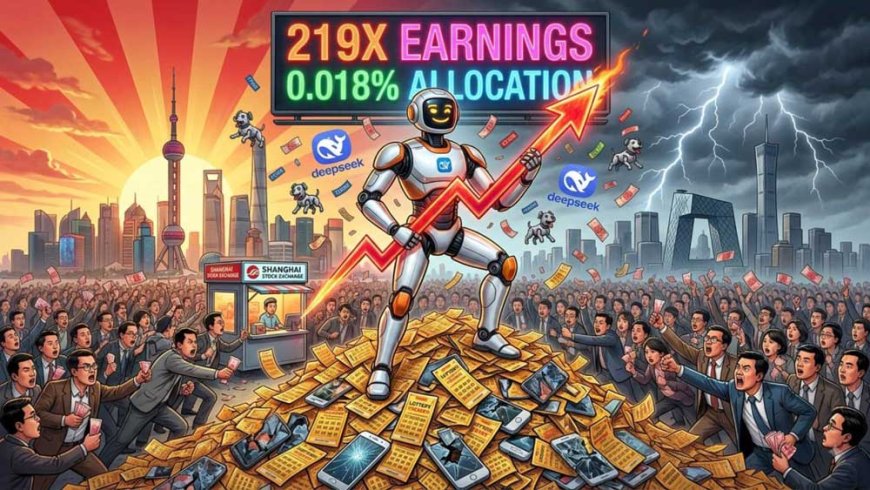
That is: how 9.8 million Chinese people decided that a stock at 219 times earnings is a bargain, and they're right, until someone dumber comes along.
If you've ever thought playing the lottery was a mathematical scam, try Unitree Robotics' IPO. On August 10, 2026, on Shanghai's STAR Market, the first Chinese company listed exclusively for humanoid robots opened subscriptions. The result? An oversubscription of 8,288 times from retail investors, with an allocation rate of 0.018%.
Translated: for every 10,000 people who put in money, fewer than 2 walked away with some shares in their pockets. SuperEnalotto gives you about 1 chance in 622 million. This IPO gives you 1.8 chances in 10,000. You do the math.
And we're not talking about small change. Total orders approached 8.1 trillion yuan, about 1.2 trillion dollars, all lining up to grab a piece of an offering of just 900 million. It's as if all of Italy decided to buy an apartment in Milan, but there's only one for sale.
The Robot Worth $9 Billion (and Still Can't Make Coffee)
Unitree set the price at 150.8 yuan per share, for a valuation of about 61 billion yuan, or 9 billion dollars.
Nice, right? Too bad that figure corresponds to 219 times 2025 earnings and 36 times sales.
To put it in perspective: Apple traded at ~30 times earnings when people were still buying iPhones in droves. Tesla, in its craziest period, hit similar peaks, but at least it sold millions of cars. Unitree? It shipped 5,500 humanoid robots in 2025.
Yes, it's the world leader. Yes, revenue quadrupled to 1.7 billion yuan.
But 219 times earnings for a company that generates less revenue than Costa Cruises loses in a summer season is, technically, what financiers call "a bit expensive."
The gross margin is respectable, though, almost 60%.
So either the robots cost very little to produce, or they sell them at astronaut prices. Probably both: the average price of their humanoids has plummeted from 593,400 yuan (2023) to 167,600 yuan (2025).
Discount stuff, if you're used to paying rent in Shanghai.
Why Is Everyone Going Crazy? Three Little Magic Words
First: it's the first. The first pure humanoid robot maker listed in mainland China.
In a market where FOMO is a national sport, being first counts more than the balance sheet. It's the same logic behind people buying bored ape NFTs: if there's a "first," there's someone willing to pay more than the first.
Second: DeepSeek. Yes, that DeepSeek. The AI company that shook Wall Street in January is among the strategic investors in the IPO.
If China's most talked-about AI is putting money in, then you should too. That's the reasoning. Don't ask me if it makes sense; ask the 9.8 million subscribers.
Third: Beijing. The Chinese government has declared advanced robotics a national strategic sector.
The IPO was approved by the STAR Market listing committee in 73 days, a record.
The Founder, the Votes, and the Little American Detail
Wang Xingxing, the founder, is 32 years old, built his first robot (XDog) as a student, worked briefly at DJI, and then founded Unitree at 26.
Today he controls the company with Class A shares that carry 10 votes each.
You put in the money, he makes the decisions. Shareholder democracy, Chinese style.
Then there's the small issue that 13.3% of revenue comes from the United States, and Washington has already imposed restrictions on imported humanoid and quadruped robots.
The prospectus warns that tariffs, export controls, or loss of existing approvals could "harm overseas expansion."
But hey, who worries about trade wars when there's a robot doing backflips on TikTok?
The Probability Lesson (No One Wants to Hear)
Here's the crux: $1.2 trillion in demand for a $900 million offering. This isn't a market; it's a procession. It's not investing; it's gambling. The difference between this and a casino is that at a casino, at least you know how much you're losing.
The valuation at 219 times earnings says one thing: the market isn't buying Unitree for what it is today, but for what it hopes it will be tomorrow. And tomorrow, according to the company's plans, they should produce 75,000 humanoid robots and 115,000 quadruped robots per year.
Ambitious? Yes. Realistic? Maybe. Justifies $9 billion today? Well, if it did, there wouldn't be a need for 9.8 million people elbowing each other for 0.018% of shares.
Moral of the Story
Unitree Robotics is the epitome of everything that makes contemporary finance fascinating and terrifying: a real product (unlike many AI startups selling slides), impressive growth, government support, DeepSeek's endorsement, and a valuation that would make even a San Francisco venture capitalist blush.
Is it a bubble? Maybe. Is it the future? Maybe. Is it a great story to tell at the bar? Definitely.
My advice? If you're among the lucky 0.018% who got shares, congratulations. You've won a lottery with worse odds than the real one. If instead you're thinking of buying at the debut?
Good luck. You'll need it.